In the information-saturated world of 2025, the ability to effectively capture, connect, and leverage knowledge has become more critical than ever. While countless note-taking applications promise to organize your thoughts, few have achieved the transformative impact of Obsidian—a powerful knowledge management tool that has revolutionized how professionals, researchers, students, and creative thinkers build and navigate their personal knowledge systems.
Unlike traditional note-taking apps that treat information as isolated documents, Obsidian embraces the interconnected nature of human thought, creating a dynamic web of linked ideas that mirrors how our brains actually process and store information. This approach, known as networked thought or connected knowledge management, has made Obsidian the go-to choice for anyone serious about building a comprehensive, searchable, and infinitely expandable second brain.
The Philosophy Behind Obsidian’s Success
Obsidian’s core philosophy centers on three fundamental principles that distinguish it from other productivity tools: local storage, future-proofing, and networked thinking. Unlike cloud-based solutions that lock your data into proprietary formats, Obsidian stores everything locally in plain Markdown files, ensuring you maintain complete control over your information while guaranteeing long-term accessibility regardless of the platform’s future.
This approach resonates particularly strongly in 2025, as professionals have become increasingly aware of the risks associated with vendor lock-in and data portability. With Obsidian, your knowledge base remains accessible through any text editor, even if the application itself becomes unavailable—a level of data ownership that has become increasingly valuable in our interconnected digital landscape.
The networked thinking approach represents perhaps the most significant paradigm shift in knowledge management. Rather than organizing information hierarchically through folders and categories, Obsidian encourages users to create connections between related ideas, concepts, and pieces of information. This creates a living, breathing knowledge network that reveals unexpected insights and connections as it grows.
Core Features That Define Modern Knowledge Management
Bidirectional Linking and Graph Visualization
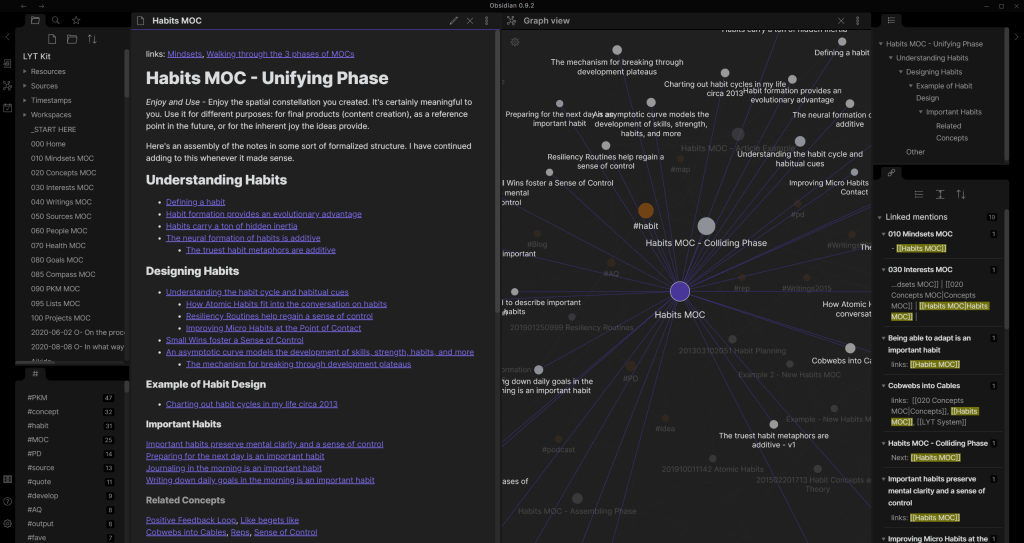
Obsidian’s signature feature is its powerful linking system that creates bidirectional connections between notes. When you link to another note, both notes become aware of the connection, creating a web of relationships that can be visualized through the interactive graph view. This visualization reveals the structure of your knowledge, highlighting central concepts, isolated ideas, and unexpected connections between seemingly unrelated topics.
The graph view has evolved significantly by 2025, incorporating advanced filtering options, temporal analysis, and AI-powered clustering that helps users identify knowledge gaps and areas for further exploration. Users can zoom from broad overview perspectives down to detailed examinations of specific knowledge clusters, making it easy to understand both the forest and the trees of their accumulated knowledge.
Plugin Ecosystem and Customization
One of Obsidian’s greatest strengths lies in its extensive plugin ecosystem, which has flourished into a comprehensive marketplace of community-developed extensions by 2025. These plugins extend Obsidian’s functionality in countless directions, from advanced task management and calendar integration to sophisticated research tools and academic citation management.
Popular plugins include advanced table editors, habit trackers, spaced repetition systems for learning retention, integration with external APIs, and powerful automation tools that can process and organize information based on custom rules. This extensibility means that Obsidian can adapt to virtually any workflow or specialized need, making it equally valuable for academic researchers, business professionals, creative writers, and personal knowledge enthusiasts.
Canvas and Visual Organization
The introduction of Canvas in recent years has added a powerful visual dimension to Obsidian’s capabilities. Canvas allows users to create infinite, zoomable workspaces where notes, images, websites, and other media can be arranged spatially. This feature has proven particularly valuable for project planning, mind mapping, research organization, and creative brainstorming sessions.
In 2025, Canvas has become an essential tool for visual thinkers who need to see the spatial relationships between ideas. Whether organizing research for a major project, planning a business strategy, or developing creative concepts, Canvas provides the flexibility to arrange and rearrange information in ways that reveal new perspectives and insights.
Practical Applications: How Professionals Use Obsidian in 2025
Academic Research and Writing
Academic researchers have embraced Obsidian as a comprehensive research management system that handles everything from initial note-taking through final publication. The platform’s ability to link sources, concepts, and arguments creates a living literature review that evolves throughout the research process.
Researchers use Obsidian to maintain extensive bibliographies with linked annotations, track the evolution of ideas across multiple papers and projects, and identify connections between disparate fields of study. The graph view often reveals unexpected relationships between research areas, leading to novel research questions and interdisciplinary insights that might otherwise remain hidden.
Many academics have developed sophisticated templating systems that standardize how they capture information from papers, books, conferences, and interviews. These templates, combined with automated tagging and linking systems, create comprehensive knowledge bases that become more valuable over time.
Business Intelligence and Strategic Planning
Business professionals have discovered that Obsidian excels at strategic thinking and decision-making processes. By linking market research, competitor analysis, customer feedback, and internal data, business leaders create comprehensive intelligence networks that inform strategic decisions with unprecedented depth and nuance.
Consulting firms and strategy teams use Obsidian to maintain institutional knowledge that persists beyond individual projects and team members. Client insights, industry trends, methodology notes, and case studies become interconnected resources that can be quickly accessed and applied to new situations.
The platform’s ability to handle both structured and unstructured information makes it particularly valuable for businesses dealing with complex, multi-faceted challenges that don’t fit neatly into traditional analytical frameworks.
Creative Development and Project Management
Creative professionals—writers, designers, filmmakers, and artists—have found Obsidian invaluable for managing the complex web of inspiration, research, and development that characterizes creative work. The platform’s flexibility accommodates the non-linear nature of creative processes while providing structure when needed.
Screenwriters use Obsidian to develop character backstories, plot threads, and world-building elements that remain consistent across long-form narratives. The linking system helps maintain continuity while the graph view reveals thematic connections and potential plot developments that might otherwise be overlooked.
Game designers and world-builders have created elaborate fictional universes within Obsidian, with detailed histories, character relationships, geographical information, and cultural elements all interconnected through the platform’s linking system.
Building Your Obsidian Knowledge System
Getting Started: Foundation Principles
Success with Obsidian begins with understanding that knowledge management is a practice, not a product. The most effective Obsidian users develop consistent habits around capturing, processing, and connecting information rather than focusing solely on organizational systems.
The key is starting small and growing organically. Begin by simply writing notes about topics that interest you, using natural language to create links between related concepts. Don’t worry about perfect organization from the start—Obsidian’s strength lies in its ability to reveal organizational patterns that emerge naturally from your thinking and linking habits.
Many successful users follow the progressive summarization approach, where they capture information first, then gradually refine and connect it over time. This process mirrors how knowledge actually develops in our minds, making it more sustainable and natural than rigid organizational schemes imposed from the beginning.
Advanced Strategies for Power Users
MOCs and Structural Notes
Maps of Content (MOCs) have become a cornerstone strategy for managing large Obsidian vaults. These structural notes serve as navigation hubs that organize and provide context for related topics without imposing rigid hierarchies. MOCs can be topical, temporal, or project-based, providing multiple entry points into your knowledge network.
Effective MOC strategies include creating different levels of abstraction—from broad subject overviews down to specific project or topic clusters. This creates a navigable structure that scales with your growing knowledge base while maintaining the flexibility that makes networked thinking so powerful.
Automation and Workflows
Advanced users leverage Obsidian’s plugin ecosystem to create sophisticated automation workflows that reduce manual overhead while maintaining the quality and connectivity of their knowledge base. Popular automation strategies include automatic tag generation, template insertion based on note types, and batch processing of imported research materials.

The Templater plugin has become particularly powerful, enabling complex dynamic templates that adapt based on context, automatically generate links to related notes, and insert relevant metadata. Combined with Dataview for querying and displaying information, these tools transform Obsidian into a sophisticated personal knowledge management system that rivals enterprise-grade solutions.
Integration with External Tools and Systems
Modern knowledge work rarely exists in isolation, and successful Obsidian users have developed strategies for integrating their knowledge base with external tools and information sources. This includes automated import from research tools like Zotero, integration with task management systems, and connection with communication platforms.
API integrations allow for automatic import of highlights from reading apps, synchronization with calendar systems for meeting notes, and export of processed knowledge to presentation tools or content management systems. These integrations ensure that Obsidian becomes a central hub rather than another isolated tool in an already fragmented workflow.
Overcoming Common Challenges
Managing Information Overload
As Obsidian vaults grow larger, users can experience information overload and difficulty navigating their accumulated knowledge. Successful long-term users develop strategies for regular review, pruning, and consolidation that prevent their knowledge base from becoming unwieldy.
The key is implementing regular maintenance routines that include reviewing orphaned notes, consolidating similar concepts, and updating MOCs to reflect the evolving structure of your knowledge. Many users schedule weekly or monthly review sessions specifically dedicated to knowledge base maintenance and optimization.
Balancing Structure and Flexibility
One of the most common challenges new Obsidian users face is finding the right balance between structure and flexibility. Too much structure can stifle the natural development of ideas, while too little can lead to chaos and difficulty finding information.
The most successful approach involves developing flexible frameworks that can evolve with your thinking while providing enough structure to maintain navigability and usefulness. This often means starting with loose organizational principles and gradually refining them based on how your knowledge base actually develops over time.
The Future of Knowledge Work with Obsidian
As we progress through 2025, Obsidian continues to evolve in response to the changing needs of knowledge workers. The integration of AI-powered features for content analysis, automatic linking suggestions, and knowledge gap identification represents the next frontier in personal knowledge management.
The platform’s commitment to local storage and user control positions it well for an era where data privacy and ownership have become paramount concerns. As regulations around data protection strengthen and users become more aware of the value of their personal knowledge assets, Obsidian’s philosophy of user ownership and control becomes increasingly attractive.
The growing integration with collaborative features while maintaining the platform’s core principles of local control represents a careful balance between individual and team knowledge management needs. This evolution acknowledges that modern knowledge work often requires both personal insight development and team collaboration.
Why Obsidian Matters for Modern Productivity
In a world where information abundance has created new challenges around attention, focus, and meaningful learning, Obsidian provides a framework for transforming information consumption into knowledge creation. The platform’s emphasis on connection and relationship building mirrors how experts in any field actually think and work.
The tool’s ability to surface unexpected connections and insights makes it particularly valuable for innovative work that requires combining ideas from different domains. Many users report that their Obsidian vault has become not just a storage system, but an active thinking partner that helps them develop ideas they might never have discovered through linear thinking alone.
For professionals seeking to build genuine expertise rather than simply managing information, Obsidian offers a pathway to deeper understanding through connected, networked thinking that compounds over time.
Conclusion: Building Knowledge That Lasts
Obsidian represents more than just another productivity tool—it embodies a fundamental shift toward treating personal knowledge as a valuable, growable asset that deserves careful cultivation. In an era where the half-life of specific information continues to shrink, the ability to build deep, connected understanding becomes increasingly valuable.
The platform’s success lies in recognizing that sustainable productivity isn’t about processing more information faster, but about building systems that help us think better, connect ideas more effectively, and develop insights that persist beyond individual projects or immediate needs.
For anyone serious about learning, thinking, or creating in 2025, Obsidian offers a powerful framework for transforming the overwhelming flow of information into genuine knowledge and understanding. Whether you’re a researcher pushing the boundaries of human knowledge, a professional navigating complex business challenges, or a creative individual developing original works, Obsidian provides the tools and philosophy necessary to build knowledge systems that grow more valuable over time.
In a world that increasingly rewards deep thinking over quick reactions, connected understanding over isolated facts, and sustained insight over momentary information, Obsidian stands as an essential tool for anyone committed to building knowledge that truly lasts.